 ballparker
Can I trust an eye estimate?
As a rough check, yes. As a measured portion, no. Your hand and the plate only describe what you can see.
A hand and a plate. Not a scale. Updated November 24, 2026.
You can estimate portion sizes by eye, and you can eyeball portion sizes without a scale, but only as a rough check. Your hand and the plate help you gauge what you can see. They are not a scale. Depth, oil, and stacked food fool the eye. A photo estimate is a different check.
Hand portion sizes here come from Precision Nutrition, not from Ballparker. Their method uses your own hand as a rough check. Hands differ, so the same cue is not the same amount of food for every person. Read their hand portion FAQ.
In their method:
Do not treat a palm, a fist, a cupped hand, or a thumb as a calorie number, a gram number, or a macro target. It is their method. Use it to notice size, then stop. It does not set a target for the meal.
The plate is only a frame. How much of it the food covers is not a measured serving.
Depth is the first trick. From above, a shallow bowl and a deep bowl can look alike. The deeper one holds more.
Stacked food is the second trick. A tall pile covers less of the plate and still hides the layer underneath. You see the top. You do not see the base.
Sauce you cannot see is the third trick. Dressing can sit under leaves. Sauce can sit under a topping. If you cannot see it, an eye check will miss it.
Some foods are easy to leave out because they do not look like a serving on the plate.
If you used oil or butter, count them in your own check. Do not assume they are already in the portion you see.
Eyeballing fails when you cannot see the ingredients, when the food is mixed, when oil or sauce is hidden, or when food is stacked so the base never shows. It also fails when you need a record you will keep. Read the label on packaged food. A label is clearer than a guess from across the table.
If you do not want a food scale, that is a different page: calorie tracking without a food scale. Your first week of logging is calorie counting for beginners.
A meal someone else cooked, a restaurant, and a holiday spread are different pages: a meal someone else cooked, restaurant calories, and a holiday spread.
An eye check is only a size cue. When you use Ballparker, the estimate is a range, and the amount starts at 1 serving. Change the amount if what you had was more or less than that, or re-estimate in plain words before you log. A fair plain-word example is “no sugar, 18% cream”.
Oil and butter are not in the estimate. Add them yourself when they matter.
After you log, edit the name, calories, or macros, or start a new photo or description. A logged meal does not re-estimate from a note.
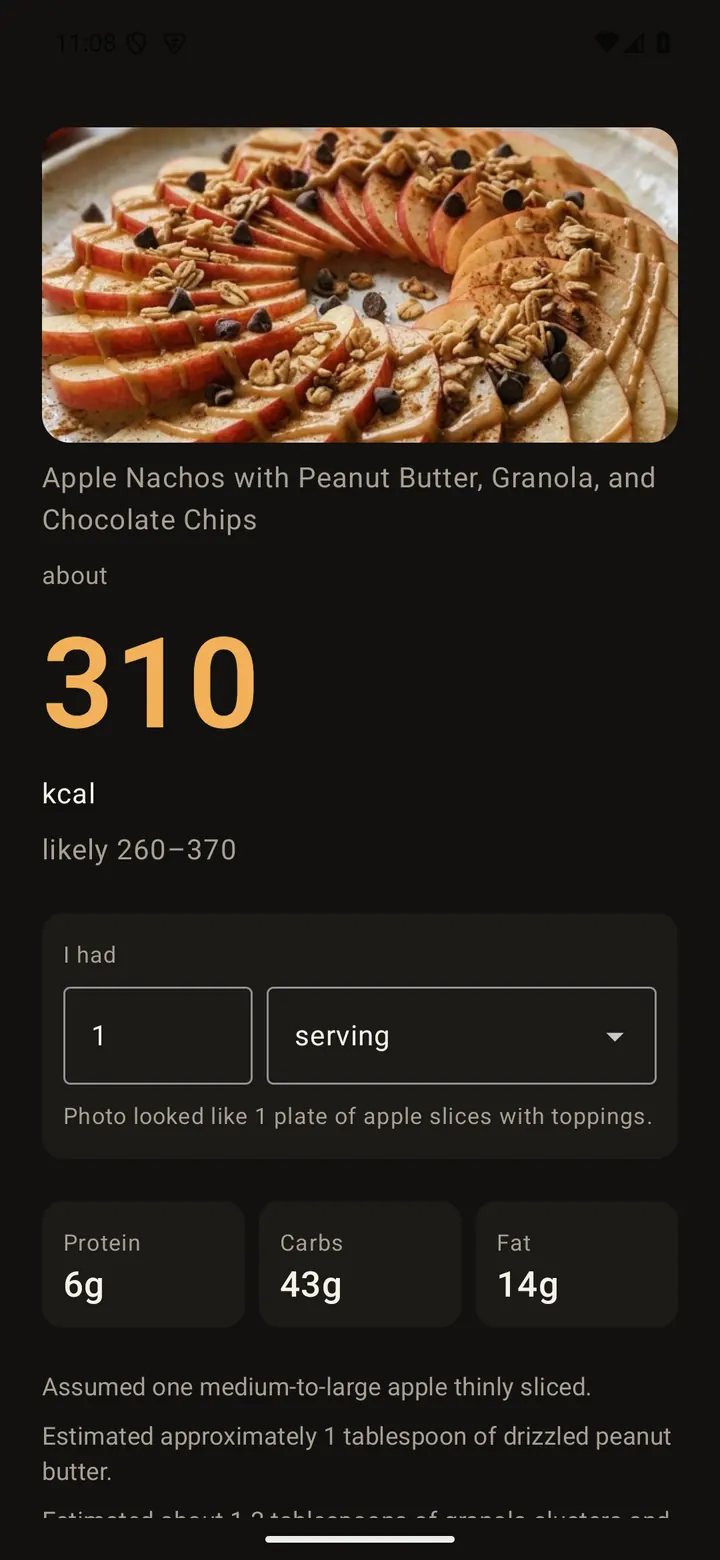
A photo estimate is not an eye check. Ballparker reads a photo or a short description and returns a likely range, not a lab count. It shows what it assumed. More on that limit is on how accurate photo calorie apps are.
Photos and descriptions are sent off only to get the estimate, and are not stored or logged. No account is required for the log to stay on the phone.
This page is not medical advice. If tracking starts to feel like it controls you, skip the log for that meal.
As a rough check, yes. As a measured portion, no. Your hand and the plate only describe what you can see.
It means you judge the portion by sight, often with your hand or the plate as a cue, without weighing the food. It is still a rough check. Depth, oil, and stacked food can fool that check.
No. Precision Nutrition’s palm, fist, cupped hand, and thumb cues are their method. A cupped hand stands in for carbs, not a starch alone. Hands differ. They are not a calorie number, a gram number, or a macro target.
A wide plate leaves more empty rim. A deep bowl hides volume. Stacked food shows the top and hides the rest.
Yes, if you had them. They are easy to miss because they are not always a mound of food on the plate. A photo estimate does not already include oil or butter. Add them yourself.
Use a label when the package has one. Use a photo when the food is mixed, hidden, or made by someone else and you still want a log. A photo gives a likely range, not a lab count, and it shows what it assumed. Before the log, change the amount or re-estimate in plain words. After the log, edit the name, calories, or macros, or start a new photo or description.
Ballparker is on the App Store and Google Play. Back to Ballparker home.
Get it on the App StoreGet it on Google Play
New subscribers start with a 7-day free trial, then a monthly or yearly plan. Cancel before day 7 and you pay nothing.